Categories
Press

The New York Times Book Review

‘Harvey’s is a story of suspense, yes. It is a story of a community crowded with shadows and secrets. But to read this novel is to experience a kind of catharsis. In John Reve, a 15th-century priest at war with his instincts and inclinations and at times even with his own flock, we find a kind of Everyman, and Harvey delivers a singular character at once completely unfamiliar and wholly universal.’

Categories
Articles

Bartering With The Facts: How a Novelist Solves a Historical Problem

An essay in Publishers Weekly on truth and accuracy in historical fiction

‘Having bestrewn my novel with pockets, for example, I discovered that the clothes of European medieval men and women didn’t have them. No pockets? Where did they put their things? Where did they put their cold hands?’

Categories
Articles Press

Brief, Brutal and Gone

An essay for Powell’s asking what anxiety is and whether people had it in the Middle Ages

‘Firstly, I don’t sleep much anymore. A year ago sleep left me. I’ve spent the year in a complex postmortem of the sort that often follows a relationship breakup. What did I do to make it leave? What can I do to get it back? Is it possible to learn to survive without it? A year of counseling, hypnotherapy, acupuncture, mindfulness, CBT, meditation, supplements, drugs, and general earnest searching has left my questions with the following answers, respectively: Unclear. Unclear. No. 

The two or three years prior to that I’d been working on a novel set in the late middle ages, whose genesis was confession — confession of the Catholic sort that happens in a booth, a little dark box. I’m not a Catholic and have never confessed, but I’m drawn to the idea of this little dark box. The waiting priest, ear to the grille. The stooped, whispering penitent. A bizarre, mystic theatre. Alongside that, mundane everydayness — spiritual absolution made routine. You come in, you confess, you agree to a penance and you are absolved; it might take less than five minutes. In the middle ages, the overworked priest urged his penitent to be brief, be brutal, be gone.’ 

Read the essay
Categories
Articles

When a Story is Best Told Backwards

An essay for Literary Hub about telling a story with a reverse narrative

Categories
Press

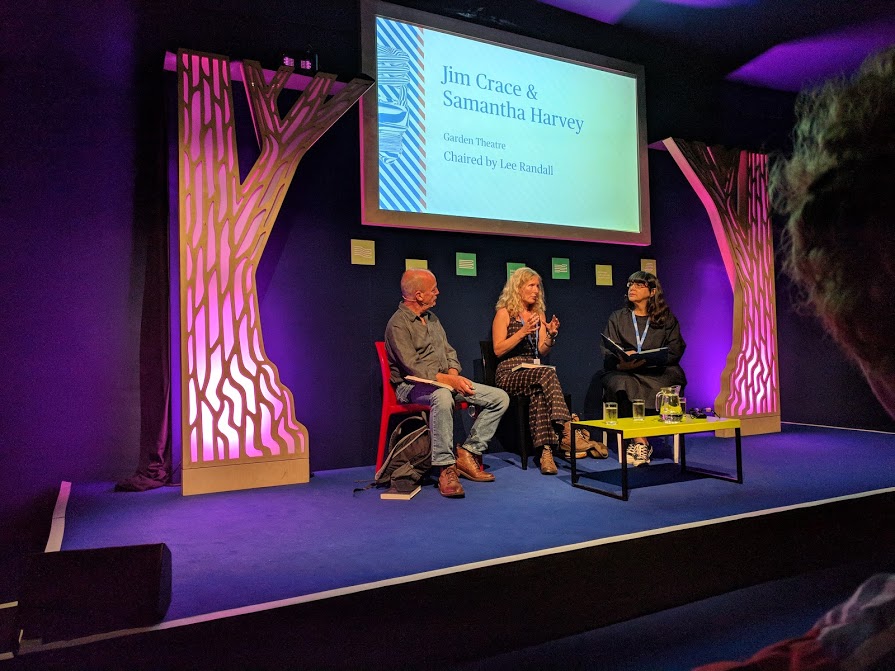
Edinburgh International Book Festival

With Jim Crace at this year’s Edinburgh Festival, 27th August 2018

Categories
Awards

The Western Wind long listed for the HWA Gold Crown Award

The Western Wind has been long listed for the Historical Writers’ Association Gold Crown Award 2018

Categories
Interviews Press

Interview for The Guardian Books Podcast

The Guardian Books Podcast: In conversation about writing The Western Wind, with Richard Lea

Author Samantha Harvey in Edinburgh by Murdo MacLeod
Categories
Articles Press

Where people say the unspeakable

Why the need to confess so often makes for great literature

An essay for The Telegraph about confession in literature

On top of Muckish Mountain in Donegal there’s a plateau of granite rocks and boulders which dwindle to stones as you reach the summit. At that summit there’s an enormous wooden cross, a silhouette against the big Irish skies and the wide blue backdrop of the Atlantic. That cross must be fortifying for some, but for me it’s always been a dull, forbidding prospect at the end of a good climb. As it comes into view it’s as if the wind strengthens and the sky darkens and I feel some resentment that it’s there, austere and punishing, on top of this lovely mountain.

Read on

Categories
Press

Publication day of The Western Wind

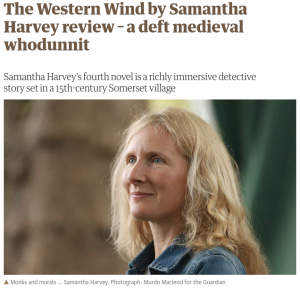
The Western Wind is published today, and reviewed by M John Harrison in The Guardian.

‘Harvey’s prose is as rich as ever, her structures clever and efficient . . . we daren’t put the book down.’

Categories
Press

Front Row

In conversation with Kirstie Lang on Radio 4’s Front Row.